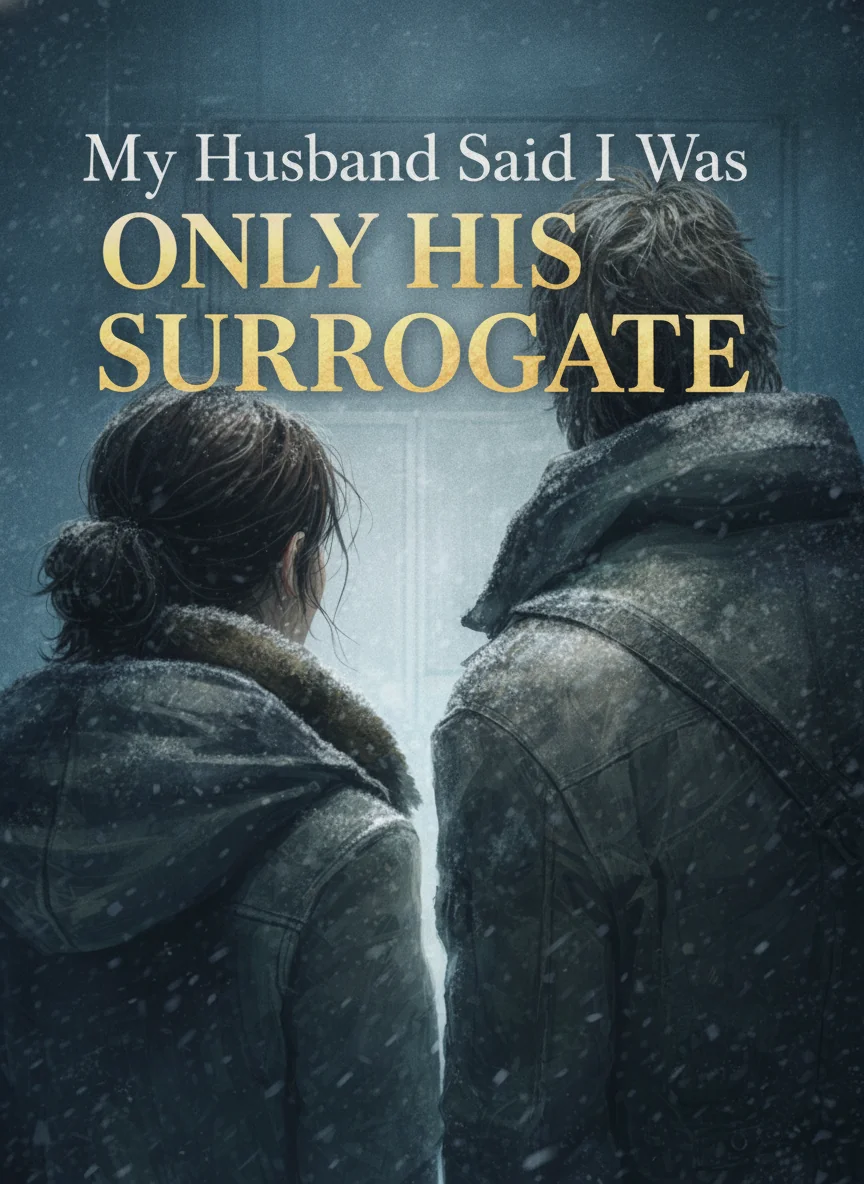
My Husband Said I Was Only His Surrogate
Chapter 4
Two years. That's how long it took before my hands stopped freezing mid-surgery.
The first year was failures. I lost patients I should have saved. I made mistakes that cost lives. Every night, I sat alone in my quarters and read their names aloud from the list I kept in a worn notebook. Private Chen. Sergeant Okoye. Corporal Davies. I forced myself to remember every face, every wound, every moment my hands had failed them.
The second year, something shifted. Not suddenly. Not dramatically. Just a slow, grinding accumulation of competence built on top of all those failures. I stopped hesitating. I stopped second-guessing. When the mortars hit and the casualties flooded in, my hands moved without asking permission from my brain.
Diana Voss noticed first. She was a medic—sharp-eyed, irreverent, with a Brooklyn accent that cut through the gray monotony of the outpost like a blade. She worked beside me during a mass casualty event when insurgents hit a supply convoy. Eight critical patients in ninety minutes. We saved six.
Afterward, she handed me a canteen and said, "You're not bad at this anymore."
I almost smiled.
The third year, winter came early and stayed late. The kind of cold that turned your breath to ice before it left your lungs. The kind that made metal burn your skin on contact.
I was three months into a rotation at a forward medical station when Command ordered an emergency supply run. Critical medications. No choice but to go.
The transport was a reinforced military vehicle driven by a specialist named Garrett who'd done this route a hundred times. I sat in back with the supplies, reviewing inventory logs by flashlight. The heater rattled. The road was a sheet of black ice pretending to be asphalt.
"Storm's getting worse," Garrett called back. "We might need to—"
The vehicle hit a patch of ice and went sideways. No drama. No screeching tires. Just a sudden, sickening loss of traction. We slid off the road, airborne for a moment, then hit the embankment hard enough to crack my head against the supply crates.
Everything went white.
When I came to, the world was tilted wrong. The vehicle was on its side, half-buried in snow. Wind howled through a crack in the roof. Garrett was slumped over the wheel, unconscious but breathing.
I tried the radio. Dead. I tried my phone. No signal.
The cold came fast. Not the kind you can fight. The kind that just takes.
I pressed my hand against the wound on my forehead. Blood, warm and wet, freezing almost instantly on my fingers. My breath came in short, painful gasps. The windows were already icing over from the inside.
I thought about the baby I'd lost. I thought about Cayson's face when he told me I was never his wife. I thought about Milena's smile.
I thought: *Not like this.*
But my body had other plans. The cold was a weight pressing down on my chest. My vision narrowed. I slumped against the crates and felt myself start to drift.
Then I heard it. Voices. Distant. Muffled by wind and snow.
Footsteps crunching closer.
A shadow appeared outside the frosted windshield. A fist slammed into the glass once. Twice. The third time, the entire windshield exploded inward in a spray of frozen shards.
A man reached through the opening. His hands were bare. Bloodied. He grabbed the frame and tore it wider, metal shrieking in protest.
"Medic!" he shouted over his shoulder. Then his eyes locked on mine. "Can you move?"
I tried to speak. Nothing came out.
He didn't wait for an answer. He climbed through the destroyed windshield, glass crunching under his boots, and crouched beside me. His hands—bleeding, knuckles cracked open—moved over me with practiced efficiency. Checking for injuries. Assessing.
"Concussion. Possible hypothermia. We need to move now."
He pulled me upright. I gasped at the sudden movement, pain flaring white-hot behind my eyes. He didn't apologize. He just lifted me—one arm under my knees, one behind my back—and carried me out through the shattered windshield.
The storm hit like a fist. Wind so strong it stole my breath. Snow so thick I couldn't see two feet ahead. The man holding me didn't slow down. He turned his back to the wind and started walking.
I drifted in and out. Time became meaningless. At some point, I realized he was talking. Not to me. To himself. Counting steps. Navigating by memory and instinct through a whiteout that should have been impossible.
"Two miles," he muttered. "Two miles. Stay with me."
I didn't know if he was talking to me or himself.
When we finally reached the outpost, he carried me straight into the medical tent and set me down on a gurney with a gentleness that didn't match the blood on his hands.
Diana appeared, already barking orders. She cut my jacket off. Started an IV. The man stepped back, his job done.
"Wait," I whispered.
He paused at the tent entrance. Turned back.
I looked at his hands. At the torn skin. The exposed bone on two knuckles.
"Your hands—"
"They're fine," he said.
They weren't fine. They were destroyed.
He left before I could say anything else.
Later, after Diana patched me up and forced hot broth down my throat, I asked who he was.
"Hayes," she said. "Leonel Hayes. He's been here longer than anyone. Doesn't talk much."
"He carried me two miles."
Diana glanced at me. "Yeah. He does that."
"Does what?"
"Shows up when people need him."
That night, I added Garrett's name to my list. He'd died before the rescue team could get him out. But I didn't read the names aloud. I just sat there, staring at the notebook, thinking about a man who'd destroyed his own hands to pull a stranger from a frozen grave.
And I thought: *That's what protection looks like.*
Not possession. Not control.
Just presence. Unasked for. Unconditional.
I'd never seen it before.
I didn't know what to do with it.
You may also like