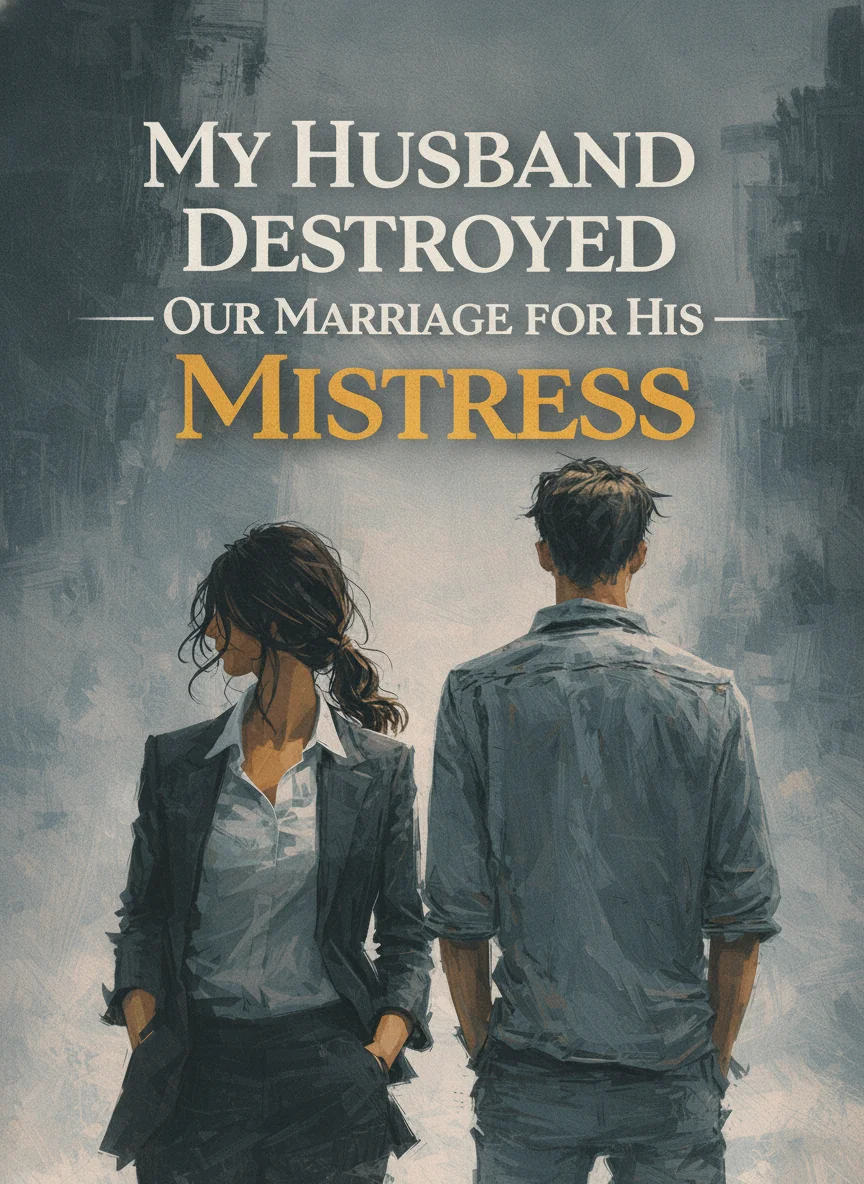
My Husband Destroyed Our Marriage for His Mistress
Chapter 2
Mount Sinai smells like every hospital smells. Bleach trying to cover something worse underneath. I've never liked that smell. My mother died under it.
I didn't run through the halls. I walked, the way I walk into board meetings, the way I walk into rooms where I already know how things will end. A nurse tried to stop me at the desk. I gave her my name. She stopped trying.
Room 412. The door was half open. I stood there a second before going in, and through the gap I could already see him — flat on the bed, one knee propped, gauze wrapped thick enough to look like a boxing glove. A doctor stood over him with a tray of instruments, and a resident hovered behind, holding a chart like a shield.
"Mr. Moreno, I really do recommend general anesthesia for this," the doctor was saying. "There's a lot of glass in there. Some of it's close to the joint capsule."
"No," Cayden said. "Local's fine."
"This isn't going to be comfortable."
"I said it's fine."
His hand was already gripping the side rail of the bed. Not resting on it. Gripping it, knuckles gone bloodless, like the rail owed him something. His jaw was tight. His eyes were fixed on the ceiling tile like it was the only thing holding the room together.
I knew exactly what I was looking at. I'd watched him do this before, three years ago, in a different room that smelled the same. Back then it had been real. Back then the pain in his face wasn't the point — the point was that he didn't care about the pain, and you could see he didn't care, and that not-caring came from somewhere true.
This was a rerun. A man trying to prove to an empty room that he was still the man from the alley. Except the room wasn't empty. I was standing in the doorway. And I don't think he even knew I was there yet, which told me something too — that he wasn't doing this for me. He was doing it for himself. Or for the ghost of himself.
The doctor noticed me first. "Mrs. Moreno—"
"Hart," I said. "Seraphina Hart."
Cayden's head turned. For a second, something in his face opened up — hope, maybe, or the hope of hope. Like he thought I'd come to hold his hand while they picked glass out of his knees. Like he thought this was the part where I told him I saw how brave he was.
"Sera," he said. His voice cracked on it, just slightly, and I couldn't tell if that was the pain or the performance.
I didn't answer. I walked to the foot of the bed and looked down at his knees, at the bandages already spotting through, dark coins blooming on white gauze. I looked at them the way I look at a balance sheet that doesn't add up. Long enough to see the problem. Not long enough to feel sorry about it.
"Doctor," I said, "can you give us a minute."
They went. Doctors always go, eventually, when you say it in that tone. The door clicked shut.
Cayden shifted against the pillows, wincing, trying to sit up straighter, trying to look like a man having a conversation and not a man who'd just had his kneecaps ground into a floor an hour ago. "They wanted to knock me out," he said. "I told them no. I can take it."
"I know you can."
"I did what I had to do tonight." His voice was building now, finding its old register, the one that used to fill a room without trying. "Victor was going to bury Oakley over eighty grand. Eighty grand, Sera. I wasn't going to stand there and let that happen to her."
I let the silence sit for a second. I wanted to see if he'd fill it. He did — he always fills silence, it's one of his tells — with more justification, more reasons, more of the story he was already writing about himself, the one where he was the hero and I was supposed to be in the audience clapping.
I looked at his knees one more time. Then at his face.
"Who was this for?" I asked.
He opened his mouth. Nothing came out right away. I watched him search for an answer that would sound like the truth and also sound good, and I watched him fail to find one that could be both. His jaw worked. His eyes dropped, just for a second, to the blanket.
"Sera—"
"That's what I thought," I said.
I turned and walked out. I didn't look back to see his face do whatever it was going to do. I didn't need to. I'd already seen enough faces like that to know.
The elevator was empty. I stood in the middle of it, hands folded, and watched the numbers tick down. I didn't cry. I didn't feel the urge to. What I felt was quieter than that, and colder, and much more useful — the particular stillness that comes after a decision has already been made somewhere beneath the part of you that talks.
I have handled a hundred acquisitions in my life. I know exactly what it feels like when something goes from priceless to worthless in a single evening. It doesn't feel like heartbreak. It feels like arithmetic.
In the car, I called Theodore.
"It's late," he said, by way of answering.
"Start preparing the agreement," I said. "All of it."
There was a pause on the line, brief, professional. Theodore has worked for me for nine years. He knows better than to ask which agreement, or why, or whether I'm certain.
"I'll have a draft by morning," he said, and hung up.
I looked out the window at the hospital shrinking behind us, its windows lit up yellow against the dark, one of them his, and I thought about nothing at all. That's a skill too. Maybe the most important one I own.
You may also like