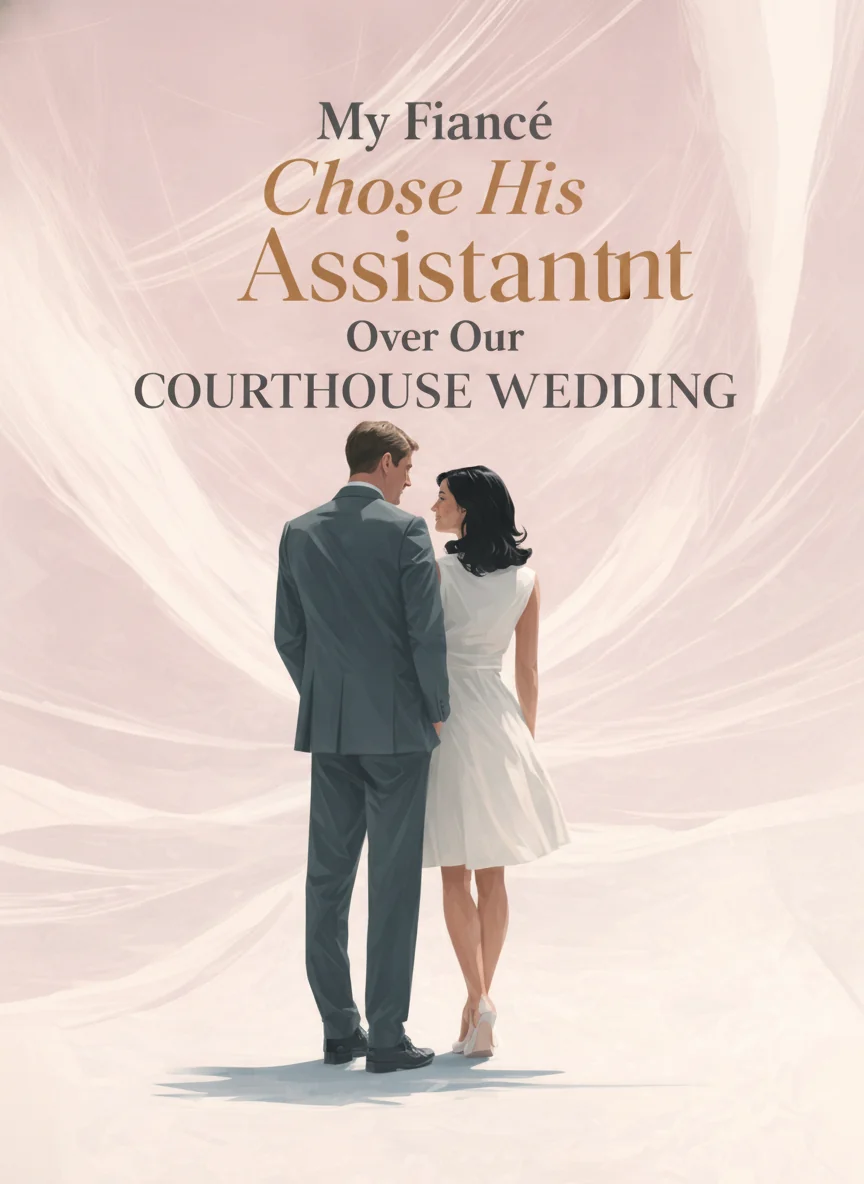
My Fiancé Chose His Assistant Over Our Courthouse Wedding
Chapter 4
The Plaza ballroom smelled like gardenias and champagne and three hundred people pretending not to watch the door.
I was mid-sentence with Corbin's CFO when I felt it — a shift in the room, the way a room shifts when something wrong walks in. The music didn't stop. The conversation didn't stop. But something tightened, like a held breath passing from table to table.
I turned.
Orion was in black. No tie. His eyes were the kind of red that doesn't come from one drink or two. He moved through the crowd like he owned the floor, and some old, trained part of me recognized the walk — the walk that meant he'd already decided how this was going to go.
He found me in four seconds.
His hand closed around my wrist before I could say a word. Not hard enough to bruise. Hard enough to mean something.
"You're doing this to punish me."
His voice was low, but the room had gone quiet enough to carry it. I felt three hundred people stop breathing at once.
My wrist was in his hand. My pulse was steady. I noticed both things with the same flat attention I bring to a bad earnings report — here is the problem, here are the facts, here is what needs to happen next.
What happened next was Corbin.
He didn't rush. He didn't raise his voice. He simply stepped forward and stood between us, and Orion's grip loosened by reflex — the reflex of a man who's used to rooms parting for him, suddenly finding one that didn't.
"Her name is Cleo Rivera-Alexander," Corbin said. Conversational. Almost pleasant. "And she has a stomach condition that requires warm meals. Never cold. If you'd known her, you'd know she's been managing that for three years."
Orion blinked. "What—"
"She doesn't wear burgundy." Corbin's voice didn't change pitch. Didn't speed up. "She doesn't wear it because the first time she saved your company forty million dollars, you dressed her down in front of your entire trading floor while the loss screens glowed behind her. She was right. You never told her so. The color stayed."
The room was so quiet I could hear the ice shifting in someone's glass.
"She taps her ring finger with her thumb when she's anxious." Corbin glanced at my hand, briefly, like he was checking something he already knew. "She drinks a specific high-altitude Colombian coffee every morning at exactly 7:15. Not 7:00. Not 7:30. 7:15, because that's the fifteen minutes before her day starts that belong entirely to her."
He paused. The pause was the worst part for Orion. I watched it land.
"You had five years," Corbin said. "Name one thing."
The silence that followed was the kind that doesn't end so much as settle — heavy and permanent, like sediment dropping to the bottom of still water.
Orion's mouth opened. Closed. His jaw worked like he was searching a room he'd never actually entered, looking for furniture that had never been there.
He couldn't name one thing. We all knew it. He knew it.
Security came quietly, the way good security always does, and Orion let himself be walked out without a word. I watched him go. I didn't feel triumph. I didn't feel grief. I felt, very distantly, the way you feel when a storm you've been tracking for days finally makes landfall somewhere else.
—
The terrace was cold. I'd slipped out for air, just five minutes, just enough sky to remember what breathing felt like when no one was watching.
I heard him before I saw him. The door. The particular sound of dress shoes on stone.
"Five minutes," Orion said. "That's all."
I turned. He looked smaller out here. The city behind him was enormous and indifferent, and he looked like a man who'd just discovered that enormity for the first time.
"I'll change," he said. His voice cracked on the second word and he didn't try to hide it. "I'll cancel everything. Every meeting, every — I'll learn it. All of it. The coffee, the color, whatever you need, I'll—"
"Orion."
He stopped.
I looked at him. Not with the anger I'd carried for years, not with the love I'd spent five years trying to keep alive. Just looked, the way you look at a place you used to live after you've moved out — recognizing the shape of it, feeling nothing that requires a name.
"You didn't forget my preferences," I said. "You never learned them in the first place. That's not something you fix in five minutes."
His mouth opened. I didn't wait to hear what came out of it.
I walked back inside.
Corbin was by the door. He had my coat over his arm — the long one, the one I'd been too distracted to grab on the way out. He held it open without a word, and I turned, and he settled it over my shoulders, and his hands stayed there for just a moment, warm and still.
He didn't ask what had been said. He didn't need to. He just fell into step beside me, back toward the light and the music and the three hundred people who'd seen everything and would remember it for years.
I tapped my ring finger once against my palm. Old habit.
Then I stopped.
You may also like