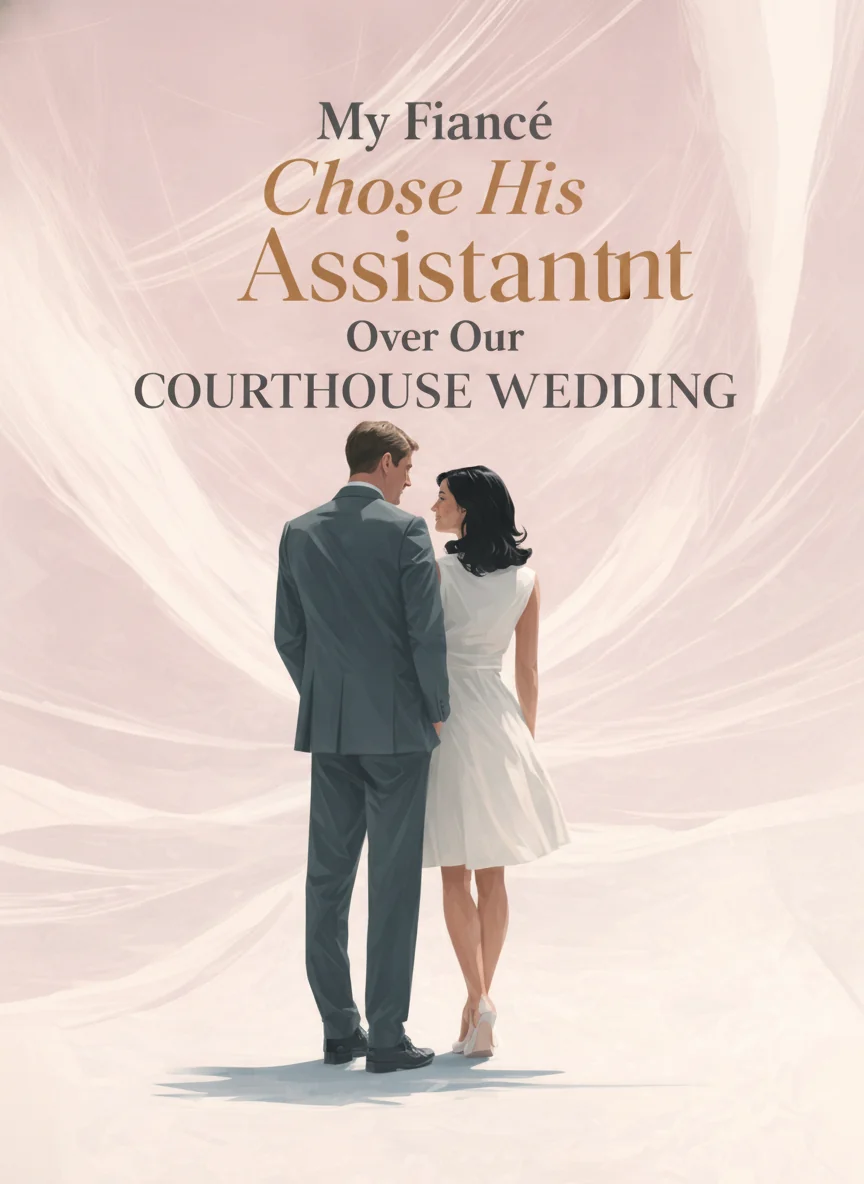
My Fiancé Chose His Assistant Over Our Courthouse Wedding
Chapter 2
The penthouse smelled like him. Cedar and dry-cleaning starch. I'd forgotten that until I stood in the doorway with an empty box in my arms, and the smell hit me, and for one second my body forgot everything my mind already knew.
I moved fast. Bathroom first — the drawer with my perfume, my hairbrush, the retainer I never wore. Bedroom second. I didn't look at the bed.
I heard the elevator before I heard him.
"Cleo." He said my name like he was pleased with himself for remembering it. He had a bouquet in one arm — white lilies, wrapped in that stiff florist paper that always smells like a funeral home — and a folded wrap over the other, deep burgundy, soft enough that I could tell it cost more than my first month's rent out of college.
"I know I've been distracted," he said. "I know timing hasn't been my strong suit lately." A pause, like he expected me to fill it with forgiveness. I didn't. "So. Peace offering."
He held out the lilies first.
"I'm allergic," I said. "Anaphylactic. There's an EpiPen in the bathroom drawer you're standing three feet from. Has been for five years."
Something flickered — not guilt, just surprise, like I'd told him the sky was a color he'd never noticed. He recovered fast. Held out the wrap instead. "Burgundy. Your favorite."
"It's not."
"Cleo—"
"Burgundy is the color the screens turned the day you called me reckless in front of forty traders." My voice stayed even. I'd practiced this in the mirror, though I hadn't planned to use it — the list just came, clean and itemized, like a report I'd been compiling for years without knowing it. "I was right two weeks later. Forty million dollars right. You never said sorry. You never said anything."
"That's not—" He stopped. Started again, quieter. "Our anniversary's in February. I got the color from—"
"March," I said. "It's in March."
For exactly one second, something honest crossed his face. Not sorrow. Confusion — the look of a man doing math that isn't adding up, checking his figures, finding the error and not understanding how it got there. I watched it happen. I almost pitied him.
Then his jaw set, and the confusion closed over like water over a stone, and he said, "You're really doing this," not as a question.
"I did it three days ago," I said, and picked up my box, and walked past him into the elevator without waiting to see if he'd say anything else. I don't think he did. I wasn't listening for it.
—
The handover at Campbell Capital took eleven minutes. I'd timed it that way on purpose — enough to transfer my files, not enough to give anyone room for a scene.
I almost made it.
"Poor thing," Iliana said, to no one in particular, in a voice pitched exactly loud enough to carry across the trading floor. She was leaning against a desk in a burgundy blouse, arms crossed, head tilted with the kind of sympathy that isn't sympathy at all. "Playing hard to get. She'll be back within the week, you watch. They always come back."
A few analysts laughed the nervous laugh people do when they're not sure if it's safe to laugh. Through the glass wall of his office, I saw Orion look up from his monitor, catch the tail end of it, and grin — the easy, satisfied grin of a man who'd already decided how this story ends.
The elevator chimed behind me.
My father stepped off first, my mother a half-step behind him, both of them dressed like they were attending something far more formal than a resignation. The floor went quiet the way rooms do when people sense weather changing.
Orion came out of his office, still smiling, like he assumed they were here to talk sense into me.
"Mr. Rivera," he said. "Good to see—"
"Cleo's wedding is next Saturday," my father said. No greeting. No preamble. Just that, flat and final, in the voice he used for closing arguments he'd already won. "Corbin Alexander. You're welcome to send a card."
The color left Orion's face in stages — first his cheeks, then his mouth, until he looked like a photograph someone had left in the sun too long. Iliana's smile stayed frozen a beat too long, like she hadn't caught up to the room yet.
My mother didn't say a word. She just took my arm, gentle and certain, and walked me to the elevator like she'd been waiting five years to do exactly that.
No one on that floor was laughing anymore.
—
He called nine times before midnight. Then, an hour later, ten more, each one lighting up my phone on the nightstand like something trying to claw its way back in. I watched the screen glow and fade, glow and fade, and felt nothing I could name — not triumph, not grief, just a low, tired hum, like a machine finally allowed to shut down.
On the twentieth call, I picked up my phone, found his name, and blocked it.
Then I turned the screen face-down, and for the first time in longer than I could remember, I slept straight through the night.
You may also like