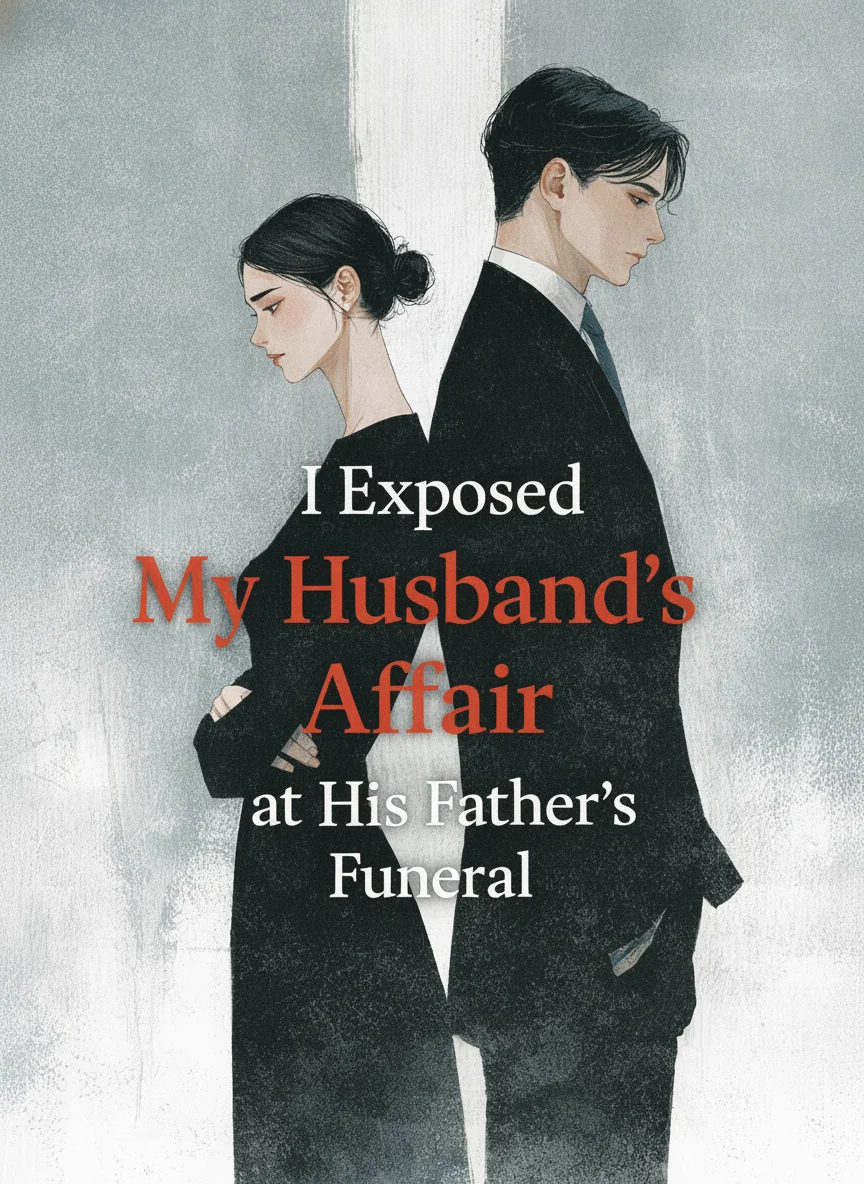
I Exposed My Husband's Affair at His Father's Funeral
Chapter 5
Nadia arrived Friday night with a leather portfolio and a bottle of wine I didn't open. She set both on the kitchen table and looked at me.
"You sure about this?"
I pulled out a chair. "Sit."
She sat. Behind her, Cora Simmons came through the door without knocking — a woman in her sixties with silver hair and a reputation that made opposing counsel settle before discovery. She'd managed my father's most sensitive affairs for twenty years. She didn't do small cases. She didn't do mistakes.
She set her briefcase on the table and opened it.
"Divorce agreement," she said. "Prepared by the best family attorney in New York. Notarized this afternoon. Irrevocable upon delivery. All it needs is his presence."
She slid the document across to me. Forty pages, bound in navy. My name on the first line. Gavin's on the second. A pen clipped to the cover.
I flipped through it. The language was clean, surgical. No room for interpretation. No room for negotiation.
"He'll contest it," Nadia said quietly.
"He can try." Cora didn't look up from her briefcase. "Your father's firm is representing Mrs. Martin. Gavin's assets are already frozen pending forensic review. His credit lines were quietly pulled this morning. By the time he realizes what's happening, it'll be over."
I looked at the signature line at the bottom of the last page. My name already there in black ink.
"When do I give it to him?"
"After," Cora said. "After everything else. When he has nothing left to stand on."
I signed my copy and slid it back.
Nadia pulled out her phone. "The screen's being installed tomorrow morning at eight. I briefed the tech crew. They think it's a memorial slideshow. Standard setup. They'll have the remote ready for you by noon."
"Good."
"Rae." She leaned forward. "Once you start this, there's no stopping it. You understand that?"
I met her eyes. "I've understood that for eighteen months."
She nodded slowly, then stood. Cora packed her briefcase and followed her to the door. Neither of them said goodbye. They didn't need to.
I sat alone at the table with the signed agreement in front of me. The house was silent. Gavin wasn't home. He'd texted an hour ago: *Staying out tonight. See you tomorrow.*
I went to bed at ten and slept six hours without waking.
Saturday morning, I woke at five and didn't run. I showered, dressed in black — a dress of devastating simplicity, no jewelry except the emerald ring on my right hand — and drove to the funeral home alone.
The screen was already mounted behind the altar when I arrived. Massive. Impossible to miss. The tech was running a test pattern, colors bleeding across the white surface.
"It's ready," he said, handing me a small black remote. "Press this button when you're ready. It'll start automatically."
I slipped it into my pocket.
People started arriving at one-thirty. I stood near the entrance and watched them come. Managing partners in dark suits. Families whose names were on buildings. A senator's chief of staff. Two financial reporters I recognized from the Journal.
Quentin Foster arrived at one-fifty-five.
He didn't announce himself. He simply appeared in the doorway, tall and still, his presence shifting the gravity of the room before he'd taken a single step. He walked to the front row, positioned himself near the window — that lifelong habit of his, reading the room before committing — and sat.
Erin Johnston was already there, hands folded in her lap, eyes fixed on the door. She didn't look at my father. He didn't look at her. But I saw the single quiet nod they exchanged, and I knew: they understood what was coming.
The room filled. Every seat. People standing along the back wall.
Two o'clock came and went.
Two-fifteen.
Then, at two-twenty, the doors opened.
Gavin walked in.
Milena was on his arm.
He was wearing his finest suit, the one he'd bought for a gala last year and never worn because I'd told him it was too much. His cufflinks caught the light. His hair was perfect. He looked like a man arriving at a party, not a funeral.
Milena wore red.
They walked down the center aisle slowly, deliberately, heads turning as they passed. Gavin's mouth was set in something that wasn't quite a smile but wasn't grief either. Satisfaction, maybe. Vindication.
He looked at me once as he walked past the front row, and his eyes said: *See? This is what moving on looks like.*
Then he looked up.
At the portrait on the easel beside the casket.
His face went white.
The room went silent.
Derek Martin stared back at him from the photograph — smiling, warm, alive in a moment three years gone — and Gavin's legs buckled.
He caught himself on the edge of a pew. His hand slipped. He went down on one knee.
Milena grabbed his arm, but he shook her off, staring at the portrait like it was something that couldn't be real, something his brain refused to process.
"No," he said. His voice cracked. "No, that's not—"
Quentin Foster stood.
The room shifted. Every head turned. My father didn't raise his voice. He didn't need to.
"Gavin Martin," he said. His voice carried the weight of thirty years on Wall Street, of fortunes built and destroyed with a single phone call. "You're done."
Gavin looked up at him, his face blank with shock.
"Effective immediately," my father continued, "you are blacklisted from every major financial institution, private equity firm, and investment fund in this country. Your name will not appear on a single board. Your calls will not be returned. Your reputation is finished."
The room didn't breathe.
I stepped forward.
I walked down the aisle, the signed divorce agreement in my hand, and stopped in front of my husband.
He looked up at me from his knees. His mouth opened. No sound came out.
I threw the papers into his face.
They hit his chest and scattered across the floor.
"We're done," I said quietly.
Then I turned to the altar, pulled the remote from my pocket, and pressed the button.
The screen behind Derek's portrait lit up.
You may also like