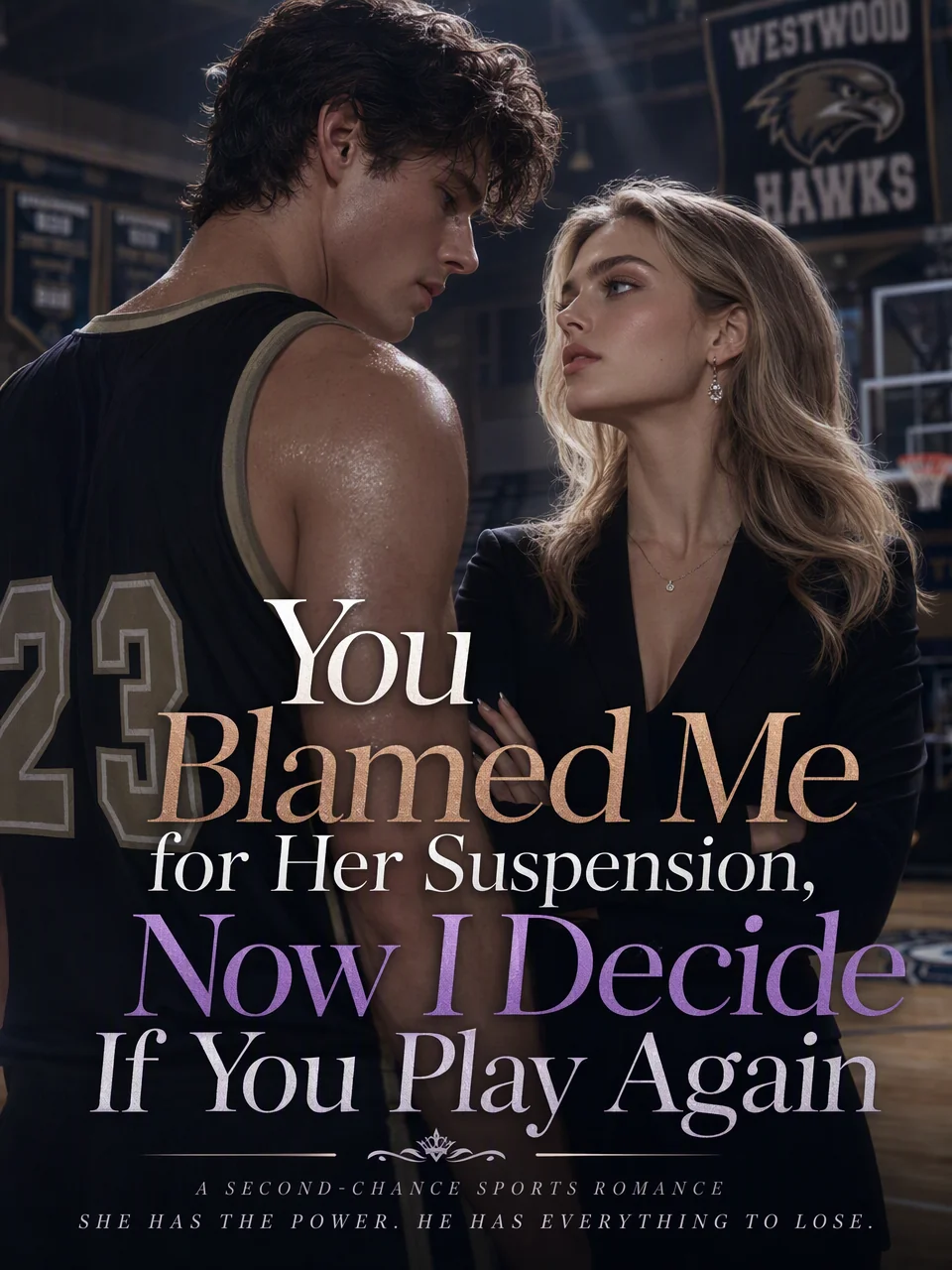
You Blamed Me for Her Suspension, Now I Decide If You Play Again
Chapter 3
With less than forty-eight hours until Game Six, the pressure inside the arena felt like a sealed boiler.
I sat behind the desk in the medical suite, facing a united front. Mark Caldwell stood by the window with his arms crossed, flanked by head coach Dave Vance and two representatives from the franchise's hockey operations department.
Mason sat in the middle, looking exhausted but stubbornly upright.
A fresh sheet of paper slid across the desk toward me. It was a formal legal waiver drafted on team letterhead, complete with a notarized stamp.
"I sign it, you stamp it, and the league is shielded from all liability," Mason said, his voice flat and gritty. "If I take a hit and get dizzy, that's on me. Just give me a non-contact practice jersey for today's skate."
I didn't even pick up the pen. I pushed the document back across the laminate surface.
"The collective bargaining agreement doesn't recognize personal waivers for head trauma," I said. "You cannot sign away league concussion protocol any more than you can sign a waiver to play without a helmet."
"Dr. Ramos, be reasonable," Mark urged, stepping closer. "We are asking for thirty minutes of light skating. No body checks. No scrimmage drills. The team needs its captain on the ice to maintain morale."
"He isn't cleared for light skating," I said, meeting Mark's gaze. "He reported zero symptoms this morning, but his biometric telemetry logged three separate heart rate spikes above one hundred and forty beats per minute while he was sitting in the video room. That indicates autonomic dysregulation. He's nauseous, he has a localized headache behind his right ear, and he lied on his morning assessment."
Mason’s jaw tightened. "I had bad coffee."
"You have a bruised brain, Mason," I replied coldly. "And you don't get to gamble with second-impact syndrome just to prove a point to the media."
The senior hockey operations representative cleared his throat nervously. "Dr. Ramos, from a roster perspective, the entire postseason is tied to this series. Is there truly no middle ground?"
"None," I said. "My responsibility is the player's brain, not your broadcast metrics. Meeting adjourned."
Mark exhaled sharply, gesturing for the executives to step out. Coach Vance lingered for a second, casting a troubled glance at Mason before following the group into the corridor.
Mason remained in his chair, staring at me with quiet rage. Before he could speak, the wall-mounted television above the reception desk flickered as the sports network replayed a clip from Boston from the previous afternoon.
Cole Bennett, the captain of the defending champion Boston Blades, stood at the podium for his post-practice media availability. His team had already punched their ticket to the League Finals the night before, sweeping their series in four straight games.
A reporter raised a microphone. "Cole, the league's independent board just placed Mason in concussion protocol, putting his Game Six status in serious jeopardy. As a competitor who might face him in the Finals, are you relieved to see your biggest rival sidelined?"
The media room went quiet, waiting for the standard diplomatic dodge.
Cole adjusted the microphone. His expression remained calm and completely serious.
"Anyone who plays this sport knows what a head injury does," Cole said clearly. "If an independent doctor says he shouldn't skate, then he shouldn't skate. I learned that lesson with my own brain two seasons ago, and ignoring the medical staff almost ended my life."
The reporter pressed further. "Some critics are claiming Dr. Ramos has a personal conflict of interest regarding Mason."
"Dr. Ramos is one of the top trauma neurologists in the country," Cole replied without a second of hesitation. "She cleared me through the strictest return-to-play process in league history last year, and I'm playing the best hockey of my career because of it. Her word is the only word that matters in that room."
The broadcast cut back to the studio analysts, but the room felt suddenly hollow.
Mason slowly turned his head away from the screen, his eyes burning into mine. The veins in his neck were raised, his knuckles white against his knees.
"How long have you two been in touch?" Mason asked, his voice dangerously low.
"Cole Bennett was a patient of mine during his rehab program in Boston," I said evenly. "Nothing more."
"Right," Mason scoffed, standing up so abruptly his chair scraped against the tile. "The captain of the team waiting for us in the Finals just happened to give a national endorsement to the doctor holding me off the ice. Are you working for his front office, Tessa? Or are you just enjoying watching me bleed from the sidelines?"
"Sit down for your secondary tracking test, Mason."
"I am sick of your tests."
"Sit down, or I will mark you as non-compliant and stop today's evaluation."
He glared at me for three long seconds before dropping back onto the exam stool.
I grabbed the digital penlight and stepped in front of him. "Look straight at the red marker on the wall. Keep your head still."
I moved the light across his peripheral field. This time, the reaction was immediate. His left eye hitched, stuttering twice as it attempted to track the beam across the midline. A subtle twitch pulled at the corner of his temple.
"Your saccadic latency is up forty milliseconds compared to yesterday," I said, clicking the light off and entering the telemetry into the master log. "Your ocular tracking deficit is worsening. You are strictly prohibited from all hockey activities, physical conditioning, and ice access for the next forty-eight hours."
Mason stared at the floor, his chest heaving with silent fury.
"Get out," I said quietly.
He stood up, snatched his team jacket off the hook, and walked out without another word, slamming the heavy wooden door behind him.
I sat back down, rubbing the bridge of my nose as the monitor saved the disqualification order. Through the office window, I saw Mason pause near the equipment storage room at the end of the hall. He spoke briefly to a rookie equipment assistant, leaning close. A moment later, the assistant reached into a lockbox, handed Mason a spare plastic access lanyard, and scurried away.
Mason shoved the card into his pocket and turned the corner toward the lower tunnel.
My stomach dropped.
Before I could reach the door, the muffled echo of a horn sounded from the arena bowl, followed by a sudden roar of cheers from the coaching staff and the players already on the ice.
I grabbed my tablet, threw the office door open, and ran down the concrete hallway toward the home bench.
The cold air hit me as soon as I pushed through the double tunnel doors.
On the ice, the entire first line was running high-speed transition drills. In the center lane, wearing his full armor, his number twenty-four sweater, and a dark visor, Mason was flying across the neutral zone at top speed.
"Mason! Stop!" I shouted, but my voice was swallowed by the blaring arena music and the scrape of steel blades against fresh ice.
Coach Vance was blowing his whistle near the blue line, unaware of the failed neurological test.
Mason picked up a pass off the left boards, cutting hard toward the center.
Then, everything went wrong.
As he crossed the center line, his shoulders jerked violently. His head snapped back as if he had run into an invisible wall. I could see it from fifty feet away—the sudden loss of spatial orientation, his vision closing down under the extreme cardiac load.
He tried to execute a sharp transition turn toward the right circle, but his balance failed completely. His skates caught a rut in the ice, his knees buckling beneath him.
He was moving at over twenty miles an hour, heading directly toward the reinforced dasher boards in the corner with no control over his momentum.
"Watch out!" Vance screamed, dropping his clipboard.
I didn't stop to think. I tossed my tablet onto the bench, planted both hands on the wooden boards, and vaulted straight over the barrier onto the slick ice.
You may also like