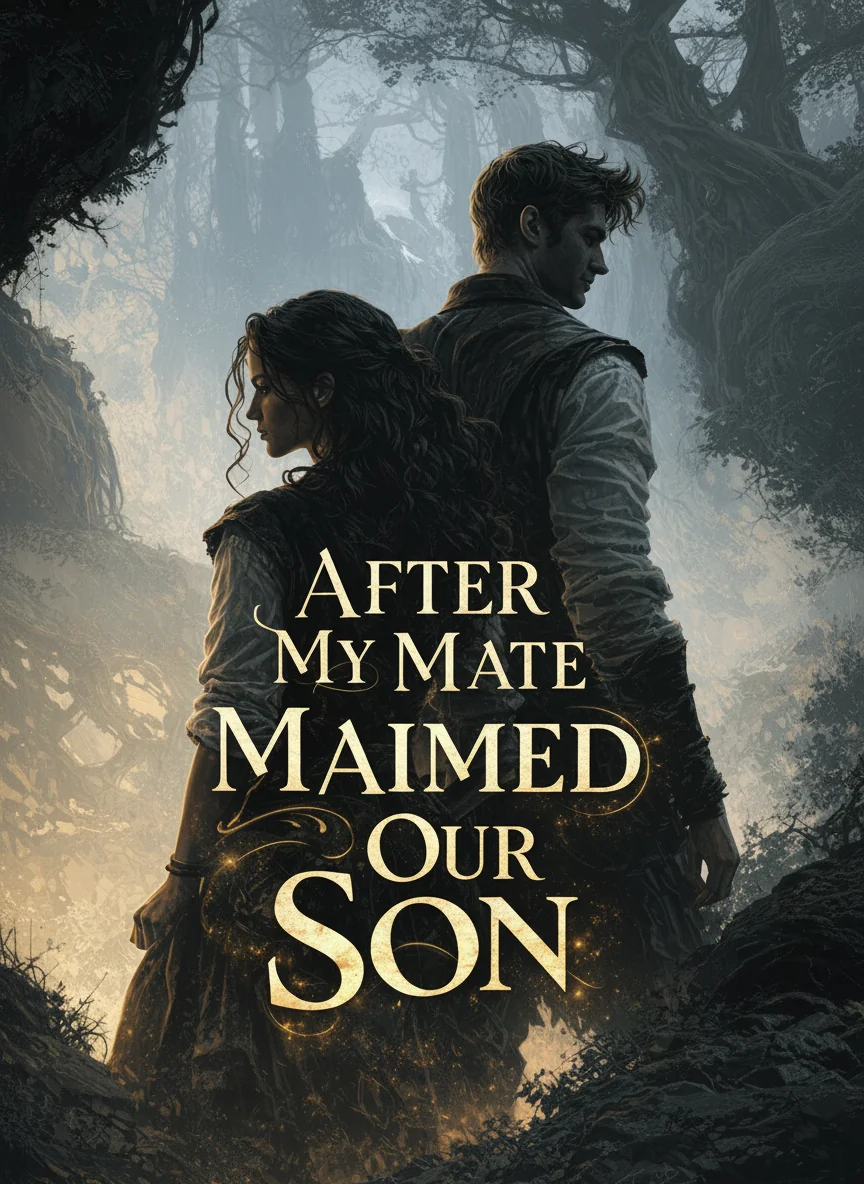
After My Mate Maimed Our Son
Chapter 3
The stone under my cheek was so cold it stopped being cold and started being a kind of heat.
I did not try to get up right away. My ears were ringing in two different pitches, and when I blinked, the courtyard tilted sideways like a boat. Warm wet ran into my eyebrow and pooled against the bridge of my nose. I counted my teeth with my tongue. All there. Good.
I heard boots scuff. Then a smaller, lighter step — careful, the way you step when you don't want anyone upstairs to hear.
"Luna," someone whispered. "Don't move. Please."
I knew the voice before I placed the face. Mira. The omega girl whose third rib I had set two winters back, when a drunk warrior had kicked her into a woodpile. She had been fifteen then. She was seventeen now, and she was kneeling in the snow pressing a kitchen cloth to my temple with hands that shook worse than mine.
"I'm not Luna," I said. My mouth tasted of copper.
"You are to me." She bit her lip, glanced over her shoulder at the pack-house windows, and leaned closer. "Listen. I only have a minute. Haven goes out at night. Past the north fence, past the sentry rotation. Three times this week. She meets men I don't know. They don't smell like pack."
I held very still.
"The armory," Mira went on, the words tumbling now, "the logs don't match. Silver stores keep dropping and nobody signed for them. And last week — the ambush on the east line, the two warriors — the blades that cut them were ours. Silverfang stamp on the hilt. I saw them bring the bodies in. I saw."
I did not move my head. I moved only my eyes, to her face. "How many have you told?"
"No one. You're the first." Her throat worked. "You stitched my rib. You didn't tell my father who did it. I remember."
"Mira." I wet my lip. "Go inside. Walk, don't run. Burn the cloth when you're done with it. Do not look back at me."
She pressed the cloth into my hand, closed my fingers around it, and was gone.
I lay there another minute, because I needed the minute. I filed every word she had said into the place in my head where I kept drug dosages and bleed-out times — the shelf that did not forget.
Then I got up.
I walked out of the Silverfang gates on my own feet, because I was not going to be carried off that ground a second time. Half a mile down the road, out of sight of the sentries, I sat against a dead oak and opened my kit. I threaded a curved needle by feel. I did not have a mirror and I did not need one. Four stitches above the hairline, pulled tight, knotted twice. The pain was clean and useful. It gave me something to breathe against.
When I stood up again, the ringing in my ears had resolved into one note, low and steady, like a struck bell.
---
I wrote the letter at Greta's table that night, after Eli went down.
I did not grieve over the paper. I did not scratch out and rewrite. I used the voice I used in clinical notes — the one that stripped a wound down to size, depth, contamination, treatment.
*To the Court of the Lycan King,* I wrote. *I am Emilia, traveling healer, mark registered in your royal infirmary ledger, Year of the Red Comet. Four years and seven months ago, in rogue border country west of the Ashfork, I removed wolfsbane from the sovereign's left lung and sealed the entry wound with cautery and sage. A boon was offered. It was not taken. I take it now.*
*I require sanctuary for myself and my son, who is four years old and has been maimed with silver. I do not require coin. I do not require vengeance. I require a locked gate and clean water, and a bed he can sleep in without listening for boots.*
*The matter is time-urgent. The hand that cut him intends to finish the work.*
I pressed my healer's mark into the hot wax — the small, three-leaf stamp Callahan's own house-healers had copied into their records the morning after I disappeared. I did not sign it with Luna. I signed it with my given name only.
The courier came at moonrise. He was a lean man with a rogue's jaw and a trader's eyes, and he owed me his mate and his daughter both — I had turned that birth around with my hand inside her, in a barn, by lantern. He took the letter without reading the direction. He read my face instead.
"How fast," I said.
"Eight days to the northern pass. Three more to the stronghold."
"Make it nine and seven."
He tipped his chin and was gone.
I stood in Greta's doorway and watched the dark eat him. I did not feel relief. I felt the small, cold click of a lever thrown.
---
The weeks after that folded into each other like clean linen.
Eli healed on the outside. The stump went from black to the dull red-brown of old brick, and the fever broke, and the fever did not come back. Greta showed me how to stretch the scar tissue so the mitt would fit without pinching. I showed her how to brew the sage stronger.
He did not speak.
He drew.
He would sit at the low table by the stove with his mitt-hand tucked tight against his chest and his good hand gripping a crayon, and he would draw wolves. Rows of them. A long mother wolf with a white chest. A small pup wolf with one small paw. Sometimes a tall wolf with a crown of sticks that I understood, without being told, was Greta.
And always, in the corner of the paper, a fourth figure. Larger than the others. He started it in brown or black, roughed in the shoulders, the ears.
Then he would switch crayons to the black wax and scribble.
He scribbled until the paper went shiny. He scribbled until the point of the crayon snapped. He scribbled until the paper tore under his hand, and only then would he stop, breathing hard through his nose like a small animal that had run a long way.
I never said a word about it. I lifted each drawing when he was done, smoothed the torn edge, and folded it into the inner flap of my kit, behind the silver blades.
One night I sat across from him with my mending in my lap and watched him do it. The candle was low. His amber eyes were steady on the page. His mitt-hand was pressed flat against his sternum, the way a man presses on a wound to keep from bleeding out.
Something in my chest that had still, up to that moment, carried the faintest heat of grief for Adrian — a last coal under the ash — went cold. Not angry cold. Finished cold. The way a kettle goes cold once you've taken it off the fire and poured the water out.
And in the dark room behind my sternum, my wolf lifted her head.
She did not pace. She did not howl. She looked, for one long considering breath, at the boy at the table and the mother across from him and the fourth figure scribbled into black on the paper.
Then she lay back down.
But she had looked.
And somewhere nine miles south of us, in a pack house that still called itself ours, a Beta I had once trusted was opening a ledger by candlelight, running his finger down a column of numbers that would not add up, and beginning — quietly, carefully, without yet knowing he was doing it — to pull the first thread of the knot.
You may also like