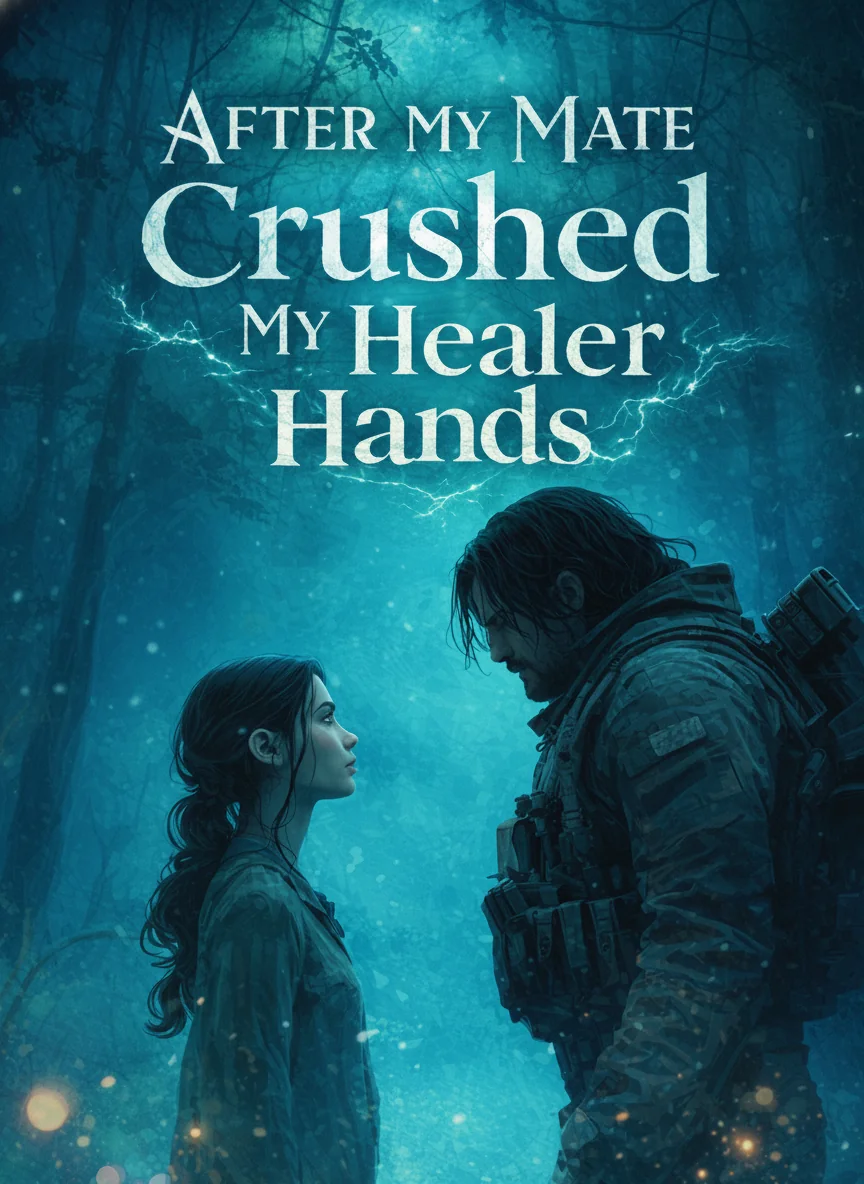
After My Mate Crushed My Healer Hands
Chapter 2
The border outpost smelled like rust and diesel fuel.
I'd been here three weeks. Twenty-one days of hauling timber, clearing rubble, and keeping my head down among rogues who looked at me like I was something they'd scraped off their boots. The overseers didn't bother learning names. They pointed and barked orders, and we moved.
No one here knew I used to mend shattered spines. No one cared.
At night, I slept in a shared bunkhouse with eleven other workers. The mattress was thin. The walls were thinner. I kept my leather case of Healer tools pressed against my chest under the blanket, the worn leather warm from my body heat. My mentor had given me that case when I turned sixteen. "Steady hands, Elianna," she'd said. "Steady hands save lives."
I flexed my fingers in the dark. Once, twice. The old habit.
Steady.
During the day, I worked the timber line. Logs came down from the trucks, and we hauled them to the cutting stations. My palms blistered. My back ached. I didn't complain. Complaining got you noticed, and being noticed here was dangerous.
But I couldn't stop being a Healer.
On the fourth night, a rogue named Marcus dislocated his shoulder lifting a beam wrong. He sat against the bunkhouse wall, face gray with pain, trying not to make noise. The overseers didn't care about injuries unless they stopped production.
I knelt beside him. "Let me see."
He jerked back. "Don't touch me."
"I'm a Healer," I said quietly. "Was a Healer. I can fix it."
He stared at me like I'd just offered him the moon. Then he nodded.
I pressed my hands to his shoulder, feeling the displaced joint, the inflamed tissue around it. My gift stirred faint and sluggish under my skin—neglected, unused, but still there. I guided the bone back into place with careful pressure. He gasped. The joint clicked.
"Move it slow," I told him. "It'll be sore for a few days."
He rotated his arm, eyes wide. "Thank you."
After that, they came to me. Quietly. At night. Sprains, cuts, infections. I treated them with what little I had in my case and what I could improvise from the outpost supplies. I didn't charge. I didn't ask for anything.
I just needed my hands to remember what they were made for.
The overseers never said anything, but I saw them watching sometimes. Cold eyes. Calculating.
On the morning of the twenty-second day, they assigned me to the machinery deck.
The deck was a raised platform where the industrial saw cut timber into planks. It was loud, dangerous work. You kept your hands clear of the blade, your feet away from the conveyor tracks, and your focus sharp. One mistake could cost you a limb.
I'd never worked the deck before.
The overseer—a squat man named Garrett with a scar splitting his left eyebrow—pointed at the control panel. "You're running the feed today."
I looked at the machinery. The massive saw blade. The conveyor belt that pulled logs through at brutal speed. "I don't know this equipment."
"Figure it out," Garrett said. He walked away.
I stepped up to the panel. The controls were simple enough—start, stop, speed adjustment. I watched the other workers moving around the deck, hauling cut planks, clearing debris. The noise was deafening. The saw screamed.
I hit the start button.
The conveyor jerked to life. Logs rolled forward, feeding into the blade. Everything seemed fine. Routine. I kept my hands on the panel, eyes on the belt, watching for jams.
Then I heard the crack.
Not from the logs. From above.
I looked up.
The overhead support beam—the one holding the safety cage in place above the saw—was splitting. Slowly. Metal groaning under strain it shouldn't have had.
Someone had cut it. Partially. Just enough that it would give under pressure.
"Move!" I shouted.
No one heard me over the saw.
The beam snapped.
The safety cage dropped. A thousand pounds of metal and wire mesh plummeting straight down onto the deck. I threw myself backward, but my hand—my right hand, my dominant hand—was still on the control panel.
The cage hit.
I heard the bones shatter before the pain arrived.
A sharp, wet crack that sounded like branches breaking under ice. My fingers crumpled. The cage pinned my hand flat against the panel, crushing it into the steel surface. Blood spread fast.
Then the pain hit.
It was white. Blinding. A scream tore out of me that I didn't recognize as my own voice.
Workers froze. Stared. No one moved.
Garrett stood ten feet away, his face blank. Not shocked. Not horrified. Blank.
He'd known.
They'd known.
"Help her!" someone shouted. Marcus. The rogue I'd fixed.
Garrett didn't move. "Shut down the saw first. Protocol."
Protocol. My hand was crushed, and he was talking about protocol.
Marcus ran forward and heaved the cage up enough for me to pull my hand free. What came out didn't look like a hand anymore. It looked like meat. Bone shards gleamed white through torn skin. My fingers bent at angles fingers shouldn't bend.
I couldn't feel them.
I tried to flex. To test the nerves, the way I'd done a thousand times on patients.
Nothing moved.
My Healer's gift stirred weakly inside me, reaching toward the damage, trying to mend—but it was my own hand. My own shattered bones. Healers couldn't heal themselves. Not like this. Not damage this severe.
I looked at Garrett. His face was still blank.
"This was deliberate," I said. My voice came out thin. Shaking. "You cut that beam."
He turned and walked away.
Marcus wrapped my hand in his shirt. "We need to get you to a Healer."
I laughed. It sounded broken. "I am a Healer."
Was.
I stared at my ruined hand, blood soaking through the fabric, and felt something inside me crack wider than bone.
This wasn't an accident. This was a message.
Denver's message. Marleigh's message.
They wanted to take everything from me—my title, my dignity, my freedom. Now they'd taken the one thing that made me who I was.
My hands.
My gift.
My purpose.
I closed my eyes and felt the last fragile thread of hope I'd been holding onto snap clean through.
They'd finally broken me.
You may also like