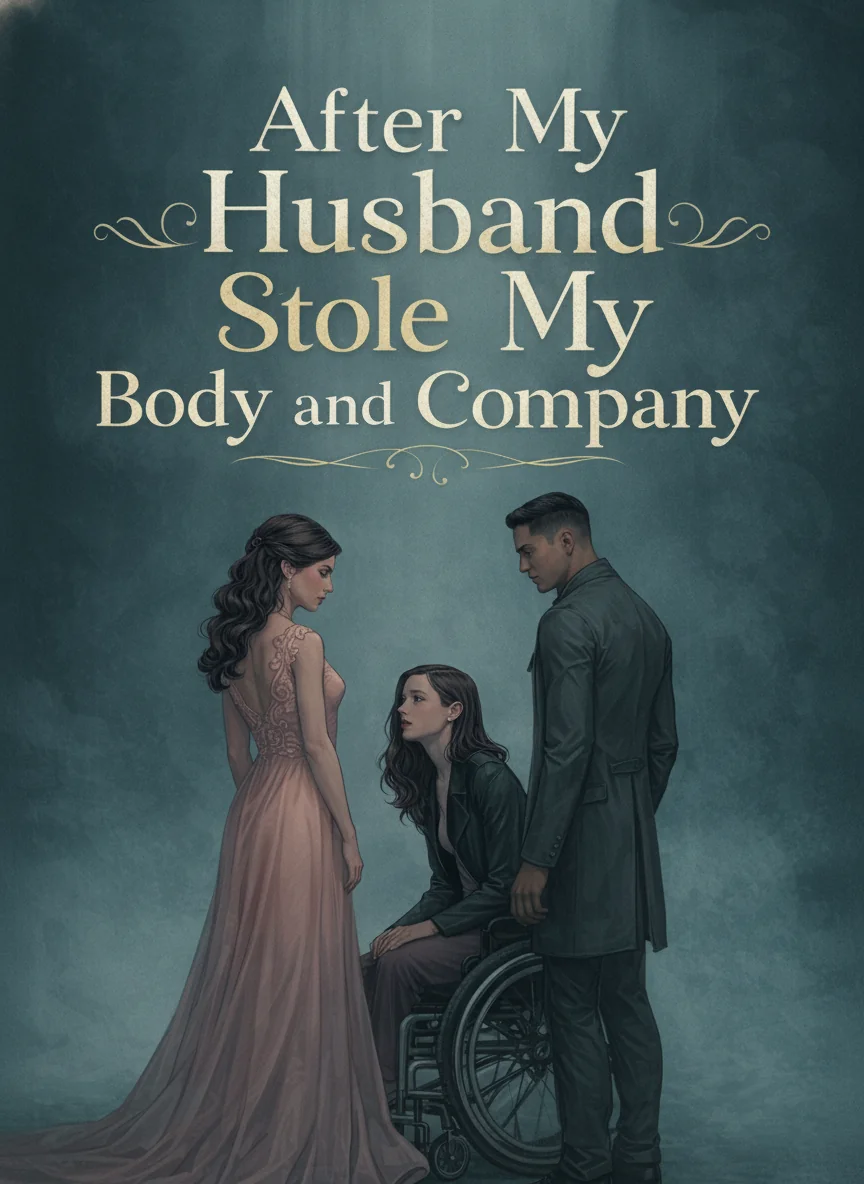
After My Husband Stole My Body and Company
Chapter 2
The wheelchair made a soft click every time the left wheel turned. I counted the clicks from the hospital entrance to the car. Then from the car to the front door of the Knight mansion. Eighty-three. Eighty-four. Eighty-five.
Lilian was waiting at the door.
She didn't come down the steps. She stood at the top, framed by the doorway, her cream Chanel suit pressed sharp enough to cut. Behind her, I could see Margaret, the head housekeeper, and two others whose names I'd never learned. An audience.
Ford wheeled me to the base of the stairs and stopped. "Mother," he said, his voice warm, easy. "We're home."
Lilian looked at me. Not at my face. At the chair.
"A wheelchair," she said. Her voice was flat, like she was reading from a list. "In my house."
I kept my hands folded in my lap. I didn't move.
"We're having the Ashfords for dinner tonight," she continued. She tilted her head, just slightly, the way you might look at a stain on expensive fabric. "A woman who can't walk should at least have the decency to stay out of sight. The chair would be distracting."
Ford made a small sound, something between a laugh and a sigh. "Mother, she just got out of the hospital—"
"I'm aware." Lilian's eyes didn't leave the wheelchair. "Margaret, have someone take her upstairs. The guest wing, I think. Quieter there."
Not our bedroom. The guest wing.
I smiled. Small, soft, the smile Ford liked. "Thank you for your concern, Lilian. I understand completely."
Margaret moved forward, her face carefully blank, and took the handles of the chair from Ford. As she wheeled me past Lilian, I caught the faintest hint of her perfume — Chanel No. 5, the same she'd worn at every family dinner for seven years. I memorized it. Filed it away with the rest.
Upstairs, alone, I opened my notebook. I wrote the date. The time. Lilian's exact words. The names of the three staff members who'd heard her say them. Then I closed the book and set it in the drawer beside the bed that wasn't mine.
The guest wing was quieter. She was right about that.
---
Sienna came that afternoon.
I heard her voice first, bright and loud, echoing up from the foyer. Then footsteps on the stairs, quick and light, the kind you make when you're not carrying anything heavy. When you're not carrying anything at all.
She knocked once and opened the door without waiting.
"Sawyer!" She smiled, wide and warm, like we were friends. Like she hadn't been the reason I couldn't feel my legs. "I heard you were back. I brought you something."
She held up shopping bags. Bergdorf's. Saks. The handles were still crisp.
"That's kind of you," I said. I didn't move from the chair by the window.
She set the bags on the bed and sat beside them, crossing her legs. The dress she wore was new. Silk, blush pink, the kind of thing that photographs well. I'd seen Ford buy dresses like that before. For me, once. A long time ago.
"Ford's been so generous lately," she said. She reached into her purse and pulled out a slim folder. "He's restructuring his portfolio. Smart, really. Diversifying."
She opened the folder and fanned out the papers inside like a hand of cards. Stock certificates. Knight Industries. The company logo printed clean and sharp at the top of each one.
"Some things are better held by people who actually appreciate them," she said. Her voice was gentle. Pitying, almost. "You understand."
I looked at the certificates. I looked at her face. I smiled.
"Of course," I said.
She stayed for twenty minutes. She talked about a charity gala. About a trip to the Hamptons Ford had promised her. About how difficult it must be, not being able to walk, and wasn't it lucky that the guest wing was all on one floor.
When she left, I wrote down the certificate numbers. All of them. My hand didn't shake once.
---
Two weeks passed like that.
Ford came to me every night. He sat on the edge of the bed and held my hand and told me how much he loved me. How we'd get through this together. How I was the strongest person he knew.
I told him I believed him.
I told him I felt safe.
I watched his face when he said my name, and I looked for guilt, for hesitation, for anything human underneath. I found nothing.
During the day, Lilian issued directives. My meals. My schedule. The physical therapist she'd hired — not to help me walk again, but to 'manage my condition.' I accepted everything without objection. I thanked her. I smiled.
And when they left me alone — which was often, because a paralyzed wife is easy to forget — I documented.
Every cruelty. Every financial transfer I overheard Ford discussing on the phone. Every visitor. Every conversation that drifted up through the vents from the rooms below.
I filled pages.
I was very, very patient.
At night, when Ford's breathing went slow and even beside me, I opened my laptop. The encrypted one, the one tied to the consultancy nobody in this family knew existed. I logged into the server. I reviewed the licensing agreements. The proprietary algorithms. The patents.
Knight Industries' most profitable contracts — the ones that kept the stock price high, the ones that paid for Sienna's dresses and Lilian's dinner parties and Ford's performance of grief — all of them ran on technology I had built. Technology I had given him, freely, because I'd believed we were building something together.
I looked at the termination clauses. I read them twice.
Then I closed the laptop and went to sleep.
I dreamed about staircases. About falling. About the sound two palms make when they hit your back, flat and sure, like someone closing a door.
You may also like