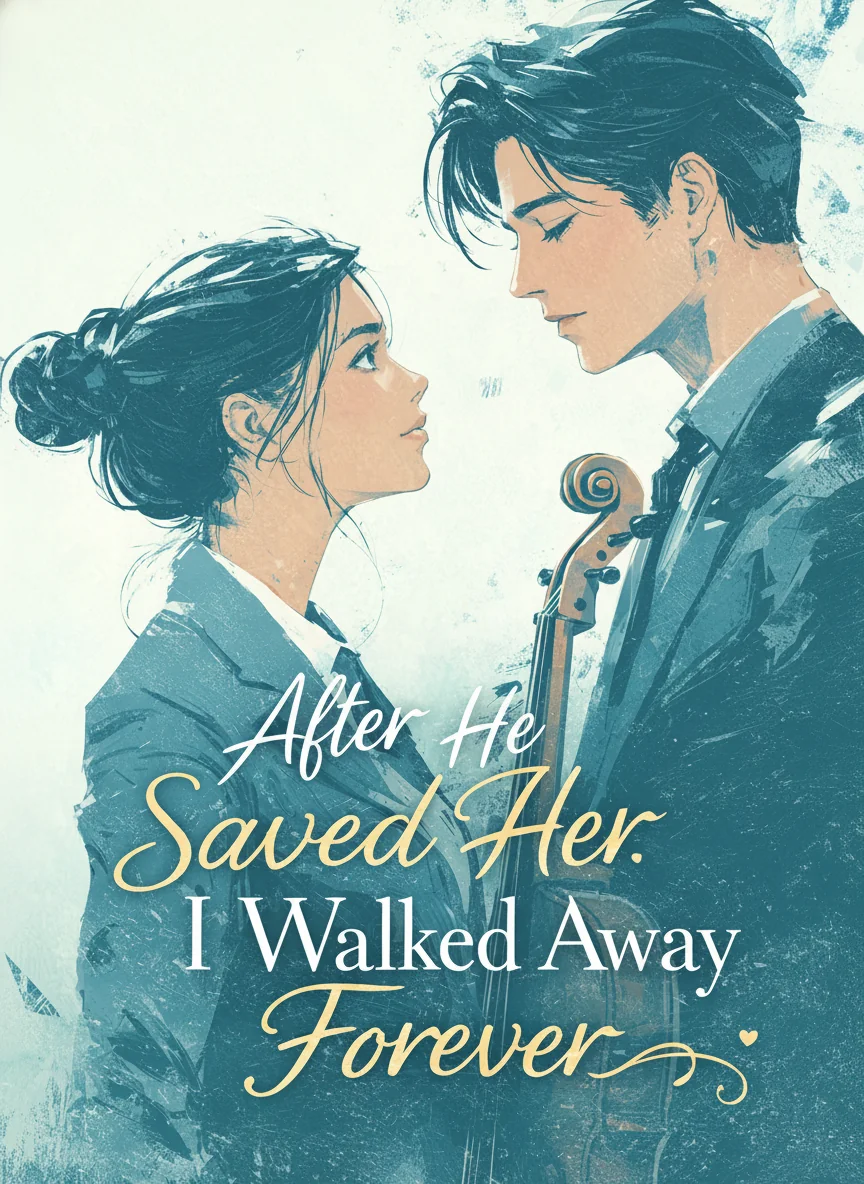
After He Saved Her, I Walked Away Forever
Chapter 1
The ceiling cracked first.
Not a sound you forget. Not a groan or a creak — a snap, like a bone breaking inside the building itself. I looked up from my music stand and saw the fracture race across the plaster above the rehearsal hall, fast and jagged, like lightning drawn in reverse.
Then the floor moved.
It rolled under my feet, and my bow skidded across the strings in a shriek that didn't sound human. Music stands toppled. Someone screamed near the back of the hall. The overhead lights swung in wide, sickening arcs, throwing shadows that lurched across the walls like living things.
I reached for Gregory.
He was four steps away. Close enough to touch. I saw his face in the strobing light — his eyes wide, his mouth open, his body already turning. Already moving.
Away from me.
His arms went around Shelby Cox. He pulled her down and covered her with his body, one hand cradling the back of her head, the other braced against the floor. It was fast. Instinctive. The kind of movement that doesn't come from thinking.
I watched it happen. I watched his hands choose.
The chunk of ceiling hit my right wrist before I could pull it back. I heard the sound before I felt it — a wet, grinding crack that was nothing like the clean snap of the ceiling. This was something organic. Something mine. My fingers went numb. My bow clattered to the floor. I dropped to my knees and the world tilted sideways, dust and plaster raining down like dirty snow.
The shaking lasted eleven seconds. I know because someone told me later, in the hospital. Eleven seconds. That's all it takes to end a life. Not the breathing kind. The other kind. The kind that makes you who you are.
When the dust settled, Gregory was still holding Shelby. Her face was pressed into his chest. His hand was still on her hair. He looked up and found me on the floor, and I watched the expression on his face shift — guilt first, sharp and immediate, and then something else. Something that flickered behind his eyes before he could catch it.
Relief.
Not for me. For her. Relief that Shelby was unharmed.
He scrambled toward me then, his knees scraping through the debris. "Alaya — God, Alaya, your hand —" His voice was high and thin. He reached for my wrist and I pulled it away from him, cradling it against my chest. The pain hadn't arrived yet. It was still somewhere behind me, gathering speed.
"Don't," I said.
The paramedics came. The hospital was chaos — cracked walls, overflowing hallways, nurses shouting in clipped British accents. They X-rayed my wrist and a surgeon with tired eyes told me what I already knew. Comminuted fracture. Multiple fragments. Surgical reconstruction could restore basic function, but the fine motor control required for professional violin performance was gone.
Gone.
Gregory sat in the plastic chair beside my bed and talked. He talked about the earthquake, about how fast it happened, about how he didn't think, he just moved. He said "I'm sorry" eleven times. I counted. He held my left hand and his thumb traced circles on my knuckles and I looked at his face and saw a man performing grief the way he performed everything — with technical precision and no idea that the audience could see the seams.
I thought about Shelby. Quiet, careful Shelby, who I'd given my Thursday performance slot because she couldn't afford to miss the showcase and I could afford to be generous. I thought about the rehearsal hours I'd arranged for her and Gregory — hours I'd suggested myself, because I trusted him completely and wanted to help her. I thought about the way he'd started mentioning her name in conversation. Small things. "Shelby has a nice interpretation of the second movement." "Shelby asked about bowing technique." I hadn't noticed then. I noticed now.
His heart had left me long before the earthquake made it visible. The ceiling just made it honest.
"We need to talk about what happens next," he said. His voice was careful. Rehearsed.
"No," I said. "We don't."
I ended it in the hospital room. No tears. No raised voice. I told him it was over and I watched his face cycle through disbelief, then protest, then the particular panic of a man who has never been told no by someone he assumed would always say yes.
"Alaya, that's not — you can't just — it was an earthquake. I didn't choose —"
"You did," I said. "Your body chose. That's the most honest thing you've ever done."
I withdrew from the Royal Academy the next morning. I blocked Gregory on every platform — phone, email, social media. I booked a one-way flight to Seattle. I packed one suitcase. I did not pack any photographs.
He found me at the departure gate at Heathrow. I don't know how. He was out of breath, his coat unbuttoned, his hair uncombed. He looked like a man who had run a long way to deliver a speech he'd been writing in his head since the hospital.
"Alaya, please. Just listen. The earthquake — it was chaos, I didn't know what I was doing. My body just reacted. It doesn't mean —"
"It means exactly what it means."
"I love you. I have always loved you. Since we were kids. You know that."
I looked at him. I looked at his face, which I had loved since I was fourteen. His jaw, his eyes, the small scar above his left eyebrow from a childhood fall. I memorized it one last time. Then I let it go.
"Your hands knew the truth before you did," I said.
I turned and walked through security. I did not look back.
Near Trafalgar Square, I heard music.
It stopped me on the sidewalk. A young man sat on a low wall outside a chapel, playing a battered violin. The piece was "Because of You" — the last piece I had been practicing before the earthquake. He played it with careful, self-taught correctness. His bowing was a little stiff, his vibrato narrow. But there was something in it. An earnestness that had nothing to do with technique and everything to do with meaning.
I stood and listened. My right wrist throbbed inside its brace, pressed against my chest. The November air was cold and damp and smelled like rain and exhaust. Pigeons scattered near my feet. The young man played with his eyes half-closed, his dark hair falling across his forehead, and he didn't notice me standing there.
I opened my violin case. The instrument lay inside on its velvet bed — the same violin my father gave me when I was twelve. I had carried it across an ocean and through a decade of my life. It was the last piece of the person I used to be.
I lifted it out and placed it in his hands.
He stopped playing. He looked at the violin, then at me. His eyes were dark and steady and surprised.
"It deserves to be played," I said.
I walked away without asking his name.
One year later, I was someone else.
Not entirely. The bones of me were the same. But the shape had changed. I was a music theory lecturer at Weston University in Seattle now. I wore structured blazers and kept my hair pinned back and stood in front of lecture halls explaining the architecture of sound to students who would go on to build things with it. Things I could no longer build myself.
I was good at it. That surprised me at first, then didn't.
I attended live performances at Benaroya Hall on Friday evenings. Always the back row. Always gone before the final note finished ringing. I cooked elaborate meals in my apartment — braised short ribs, handmade pasta, things that required hours and precision and kept my hands busy. My apartment was spare. Clean lines, neutral colors, no photographs from London on display. They lived in a shoebox on the top shelf of my closet. I hadn't opened it. I hadn't thrown it away.
Sometimes, without thinking, I pressed my left thumb against the inside of my right wrist. Feeling the ridge of scar tissue beneath the skin. Checking that the damage was still real. That I hadn't dreamed it.
I hadn't.
On the first day of the fall semester, I stood at the front of Music Theory 301 and looked out at sixty-two new faces. I introduced myself, outlined the syllabus, and began my opening lecture on structural tension in symphonic form.
Third row, center seat. A young man with dark hair and steady eyes. He sat still while the students around him shifted and whispered. He watched me with a quiet attention that felt different from the usual first-day curiosity. Not starstruck. Not bored. Something else.
After the lecture, he approached the podium. The hall was emptying around us.
"Professor Rogers?" His voice was low and unhurried. "I had a question about something you said. About Shostakovich's Fifth."
"Go ahead."
"You described the finale as a forced resolution — triumph imposed by external pressure rather than earned through internal development. But what if the structure itself is the confession? What if Shostakovich built the architecture of obedience so precisely that the absence of genuine resolution becomes the emotional center?"
I looked at him. It was not a sophomore question. It was not even a graduate question. It was the kind of question that came from someone who understood music the way an architect understands a building — not just the melody, but the load-bearing walls.
"That's a good question," I said. "What's your name?"
"Dante Mendez. Junior transfer."
I wrote it down in my attendance sheet. Dante Mendez. Third row.
I told myself I was merely noting an engaged pupil.
I told myself that all the way home.
You may also like